Cnut
Cnut ( ; ; – 12 November 1035), also known as Canute and with the epithet the Great, was King of England from 1016, King of Denmark from 1018, and King of Norway from 1028 until his death in 1035. The three kingdoms united under Cnut's rule are referred to together as the North Sea Empire by historians. As a Danish prince, Cnut won the throne of England in 1016 in the wake of centuries of Viking activity in northwestern Europe. His later accession to the Danish throne in 1018 brought the crowns of England and Denmark together. Cnut sought to keep this power base by uniting Danes and English under cultural bonds of wealth and custom. After a decade of conflict with opponents in Scandinavia, Cnut claimed the crown of Norway in Trondheim in 1028. In 1031, Malcolm II of Scotland also submitted to him, though Anglo-Norse influence over Scotland was weak and ultimately did not last to the time of Cnut's death. Dominion of England lent the Danes an important link to the maritime zone...
Cnut ( ; ; – 12 November 1035), also known as Canute and with the epithet the Great, was King of England from 1016, King of Denmark from 1018, and King of Norway from 1028 until his death in 1035. The three kingdoms united under Cnut's rule are referred to together as the North Sea Empire by historians. As a Danish prince, Cnut won the throne of England in 1016 in the wake of centuries of Viking activity in northwestern Europe. His later accession to the Danish throne in 1018 brought the crowns of England and Denmark together. Cnut sought to keep this power base by uniting Danes and English under cultural bonds of wealth and custom. After a decade of conflict with opponents in Scandinavia, Cnut claimed the crown of Norway in Trondheim in 1028. In 1031, Malcolm II of Scotland also submitted to him, though Anglo-Norse influence over Scotland was weak and ultimately did not last to the time of Cnut's death. Dominion of England lent the Danes an important link to the maritime zone between the islands of Great Britain and Ireland, where Cnut, like his father before him, had a strong interest and wielded much influence among the Norse–Gaels. Cnut's possession of England's dioceses and the continental Diocese of Denmark – with a claim laid upon it by the Holy Roman Empire's Archdiocese of Hamburg-Bremen – was a source of great prestige and leverage among the magnates of Christendom (gaining notable concessions such as one on the price of the pallium of his bishops, though they still had to travel to obtain the pallium, as well as on the tolls his people had to pay on the way to Rome). After his 1026 victory against Norway and Sweden, and on his way back from Rome where he attended the coronation of the Holy Roman Emperor, Cnut deemed himself "King of all England and Denmark and the Norwegians and of some of the Swedes" in a letter written for the benefit of his subjects. Medieval historian Norman Cantor called him "the most effective king in Anglo-Saxon history". He is popularly invoked in the context of the legend of King Canute and the tide. ==References== ==Sources== Thietmar (1962) Chronik: Chronicon; Neu übertragen und erläutert von Werner Trillmich. Darmstadt: Wissenschaftliche Buchgesellschaft
References
- ^ Lawson, Cnut , p.126 Wikipedia revision 1376916991, retrieved 2026-11-19 · 1795042800.0
- ^ Trow, Cnut , p. 128. Wikipedia revision 1376916991, retrieved 2026-11-19 · 1795042800.0
- ^ Trow, Cnut , p. 186 Wikipedia revision 1376916991, retrieved 2026-11-19 · 1795042800.0
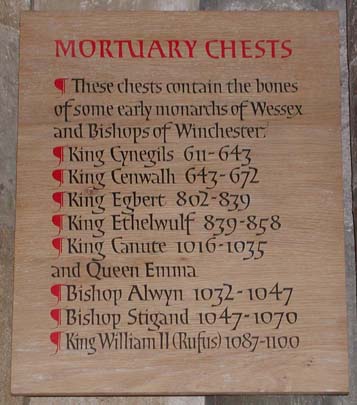
- ^ "Photo of a sign posted in Winchester Cathedral marking Cnut's mortuary chest, posted at the astoft.co.uk web site, retrieved 2009-07-25" . Archived from the original on 21 June 2009 . Retrieved 12 June 2009 . Wikipedia revision 1376916991, retrieved 2026-11-19 · 1248476400.0
- ^ https://www.jassa.org/?p=4527 jassa.org/ · bare citation; no publisher or title recorded · Wikipedia revision 1376916991, retrieved 2026-11-19 · 1795042800.0
- ^ Cantor, The Civilisation of the Middle Ages , 1995: 166. Wikipedia revision 1376916991, retrieved 2026-11-19 · 1795042800.0
- ^ Trow, Cnut , pp. 30–31. Wikipedia revision 1376916991, retrieved 2026-11-19 · 1795042800.0
- ^ Sturluson, Snorri. "The History of Olav Trygvason". Heimskringla . ch. 34, ch. 91. ISBN 9780903521949 . Wikipedia revision 1376916991, retrieved 2026-11-19 · 1795042800.0
- ^ Thietmar of Merseburg. Chronicon . Book VII. ISBN 9780719049262 . Wikipedia revision 1376916991, retrieved 2026-11-19 · 1795042800.0
- ^ Campbell, Alistair (ed.). Encomium Emmae Reginae . ISBN 9780521626552 . Wikipedia revision 1376916991, retrieved 2026-11-19 · 1795042800.0
- ^ "Cnut" Archived 8 November 2018 at the Wayback Machine . Collins English Dictionary . Wikipedia revision 1376916991, retrieved 2026-11-19 · 1795042800.0
- ^ Adam of Bremen. History of the Archbishops of Hamburg-Bremen . Translated by Tschan, Francis J. Book II, ch. 37, Scholion 25. ISBN 9780231500852 . Wikipedia revision 1376916991, retrieved 2026-11-19 · 1795042800.0
- ^ Lawson, M. K. (2011). Cnut: England's Viking King . The History Press. ISBN 9780752460697 . Wikipedia revision 1376916991, retrieved 2026-11-19 · 1795042800.0
- ^ Sawyer, Birgit (2000). The Viking-Age Rune-Stones . Oxford University Press. ISBN 9780199262212 . Wikipedia revision 1376916991, retrieved 2026-11-19 · 1795042800.0
- ^ Douglas, English Historical Documents , pp. 335–36 Wikipedia revision 1376916991, retrieved 2026-11-19 · 1795042800.0
- ^ Edwards, Paul and Pálsson, Hermann (trans.), Knytlinga saga: the history of the kings of Denmark , Odense University Press (1986), p. 43. Wikipedia revision 1376916991, retrieved 2026-11-19 · 1795042800.0
- ^ Trow, Cnut , p. 92. Wikipedia revision 1376916991, retrieved 2026-11-19 · 1795042800.0
- ^ John, H., The Penguin Historical Atlas of the Vikings , Penguin (1995), p. 122. Wikipedia revision 1376916991, retrieved 2026-11-19 · 1795042800.0
- ^ Modern languages: Danish : Knud den Store or Knud II ; Norwegian : Knut den mektige , Swedish : Knut den Store . Wikipedia revision 1376916991, retrieved 2026-11-19 · 1795042800.0
- ^ William of Malms., Gesta Regnum Anglorum , pp. 308–10 Wikipedia revision 1376916991, retrieved 2026-11-19 · 1795042800.0
- ^ Trow, Cnut , p. ???. Wikipedia revision 1376916991, retrieved 2026-11-19 · 1795042800.0
- ^ Bolton, Timothy (2009). The Empire of Cnut the Great: Conquest and the Consolidation of Power in Northern Europe in the Early Eleventh Century . Brill. p. 248. ISBN 978-90-04-16670-7 . Archived from the original on 14 April 2023 . Retrieved 12 October 2021 . Wikipedia revision 1376916991, retrieved 2026-11-19 · 1795042800.0
- ^ Garmonsway, G.N. (ed. & trans.), The Anglo-Saxon Chronicle , Dent Dutton, 1972 & 1975, Peterborough (E) text, s.a. 1015, p. 146. Wikipedia revision 1376916991, retrieved 2026-11-19 · 1795042800.0
- ^ Campbell, A. (ed. & trans.), Encomium Emmae Reginae , Camden 3rd Series vol. LXXII, 1949, pp. 19–21. Wikipedia revision 1376916991, retrieved 2026-11-19 · 1795042800.0
- ^ "King Cnut The Great" . Historic UK . Retrieved 9 October 2023 . Wikipedia revision 1376916991, retrieved 2026-11-19 · 1795042800.0
- ^ Anglo-Saxon Chronicles , pp. 146–49. Wikipedia revision 1376916991, retrieved 2026-11-19 · 1795042800.0
- ^ Trow, Cnut , p. 59. Wikipedia revision 1376916991, retrieved 2026-11-19 · 1795042800.0
- ^ Anglo-Saxon Chronicles , pp. 148–50 Wikipedia revision 1376916991, retrieved 2026-11-19 · 1795042800.0
- ^ Anglo-Saxon Chronicles , pp. 150–51 Wikipedia revision 1376916991, retrieved 2026-11-19 · 1795042800.0
- ^ Anglo-Saxon Chronicles , pp. 151–53 Wikipedia revision 1376916991, retrieved 2026-11-19 · 1795042800.0
- ^ Anglo-Saxon Chronicles , pp. 152–53; Williams, A., Æthelred the Unready the Ill-Counselled King , Hambledon & London, 2003, pp. 146–47. Wikipedia revision 1376916991, retrieved 2026-11-19 · 1795042800.0
- ^ Laurence M. Larson Canute the Great G. P. Putnam's Sons 1912 Wikipedia revision 1376916991, retrieved 2026-11-19 · 1795042800.0
- ^ Molyneaux, George (2015). The Formation of the English Kingdom in the Tenth Century . Oxford University Press. p. 35. ISBN 978-0-19-102775-8 . Archived from the original on 14 April 2023 . Retrieved 14 October 2021 . Wikipedia revision 1376916991, retrieved 2026-11-19 · 1795042800.0
- ^ Thietmar, Chronicon , vii. 7, pp. 502–03 Wikipedia revision 1376916991, retrieved 2026-11-19 · 1795042800.0
- ^ Article Royal Family website (2023) Wikipedia revision 1376916991, retrieved 2026-11-19 · 1795042800.0
- ^ "Record ID: LEIC-3E8CC4 – EARLY MEDIEVAL coin" . The Portable Antiquities Scheme . British Museum . Retrieved 16 July 2024 . Wikipedia revision 1376916991, retrieved 2026-11-19 · 1795042800.0
- ^ Bolton, Timothy (2009). The Empire of Cnut the Great: Conquest and the Consolidation of Power in Northern Europe in the Early Eleventh Century . Brill. pp. 41– 42. ISBN 978-90-04-16670-7 . Archived from the original on 14 April 2023 . Retrieved 19 March 2020 . Wikipedia revision 1376916991, retrieved 2026-11-19 · 1795042800.0
- ^ Westergaard, Waldemar (1917). The Danish West Indies Under Company Rule (1671–1754): With a Supplementary Chapter, 1755–1917 . Macmillan. Archived from the original on 19 January 2023 . Retrieved 22 April 2024 . Wikipedia revision 1376916991, retrieved 2026-11-19 · 1795042800.0
- ^ Graslund, B.,'Knut den store och sveariket: Slaget vid Helgea i ny belysning', Scandia , vol. 52 (1986), pp. 211–38. Wikipedia revision 1376916991, retrieved 2026-11-19 · 1795042800.0
- ^ Belloc, Hilaire (1925). A History of England . Methuen. Archived from the original on 19 January 2023 . Retrieved 22 April 2024 . Wikipedia revision 1376916991, retrieved 2026-11-19 · 1795042800.0
- ^ Trow, Cnut , p. 197. Wikipedia revision 1376916991, retrieved 2026-11-19 · 1795042800.0
- ^ Hudson, Knutr , pp. 323–325. Wikipedia revision 1376916991, retrieved 2026-11-19 · 1795042800.0
- ^ Hudson, Knutr , pp. 330–331. Wikipedia revision 1376916991, retrieved 2026-11-19 · 1795042800.0
- ^ Lausavisur , ed. Johnson Al, pp. 269–70 Wikipedia revision 1376916991, retrieved 2026-11-19 · 1795042800.0
- ^ Trow, Cnut , p.129 Wikipedia revision 1376916991, retrieved 2026-11-19 · 1795042800.0
- ^ a b ASC, Ms. D, s.a. 1031. Wikipedia revision 1376916991, retrieved 2026-11-19 · 1795042800.0
- ^ a b Anglo-Saxon Chronicles , p. 154 Wikipedia revision 1376916991, retrieved 2026-11-19 · 1795042800.0
- ^ Adam of Bremen, Gesta Daenorum , scholium 37, p. 112. Wikipedia revision 1376916991, retrieved 2026-11-19 · 1795042800.0
- ^ Ellis, Celt & Saxon , p. 182. Wikipedia revision 1376916991, retrieved 2026-11-19 · 1795042800.0
- ^ Bartlett 2016 , p. 44. Wikipedia revision 1376916991, retrieved 2026-11-19 · 1795042800.0
- ^ Bolton 2017 . Wikipedia revision 1376916991, retrieved 2026-11-19 · 1795042800.0
- ^ Coke & Hargrave 1853 , p. 20. Wikipedia revision 1376916991, retrieved 2026-11-19 · 1795042800.0
- ^ Ellis 1993 , p. 182. Wikipedia revision 1376916991, retrieved 2026-11-19 · 1795042800.0
- ^ Forte, Oram & Pedersen 2005 , p. 196. Wikipedia revision 1376916991, retrieved 2026-11-19 · 1795042800.0
- ^ Forte, Oram & Pedersen 2005 , pp. 196–197. Wikipedia revision 1376916991, retrieved 2026-11-19 · 1795042800.0
- ^ Forte, Oram & Pedersen 2005 , pp. 197–198. Wikipedia revision 1376916991, retrieved 2026-11-19 · 1795042800.0
- ^ a b c d Forte, Oram & Pedersen 2005 , p. 198. Wikipedia revision 1376916991, retrieved 2026-11-19 · 1795042800.0
- ^ Forte, Oram & Pedersen 2005 , p. 227. Wikipedia revision 1376916991, retrieved 2026-11-19 · 1795042800.0
- ^ Frank 1999 , p. 116. Wikipedia revision 1376916991, retrieved 2026-11-19 · 1795042800.0
- ^ Frank 1999 , p. 120. Wikipedia revision 1376916991, retrieved 2026-11-19 · 1795042800.0
Cite this
"Cnut". 1790460446. e01 Encyclopedia. CC BY-SA 4.0. https://en.wikipedia.org/w/index.php?oldid=1376916991