Floppy disk
A floppy disk, diskette, or floppy diskette is a type of disk storage made from a thin, flexible disk coated with a magnetic storage medium. It is enclosed in a square or nearly square plastic shell lined with fabric to help remove dust from the spinning disk. Floppy disks store digital data, which can be read or written when inserted into a floppy disk drive (FDD) connected to or built into a computer or other device. The three most popular formats of floppy disks (and their drives) are the 8-inch, 5¼-inch, and 3½-inch versions. The first floppy disks, invented and made by IBM in 1971, had a disk diameter of . Subsequently, the 5¼-inch (130 mm) and then the 3½-inch (90 mm) became a ubiquitous form of data storage and data transfer into the first years of the 21st century. By the end of the 1980s, 5¼-inch (130 mm) disks had been superseded by 3½-inch (90 mm) disks. During this time, PCs frequently came equipped with drives of both sizes. By the mid-1990s, 5¼-inch drives had...
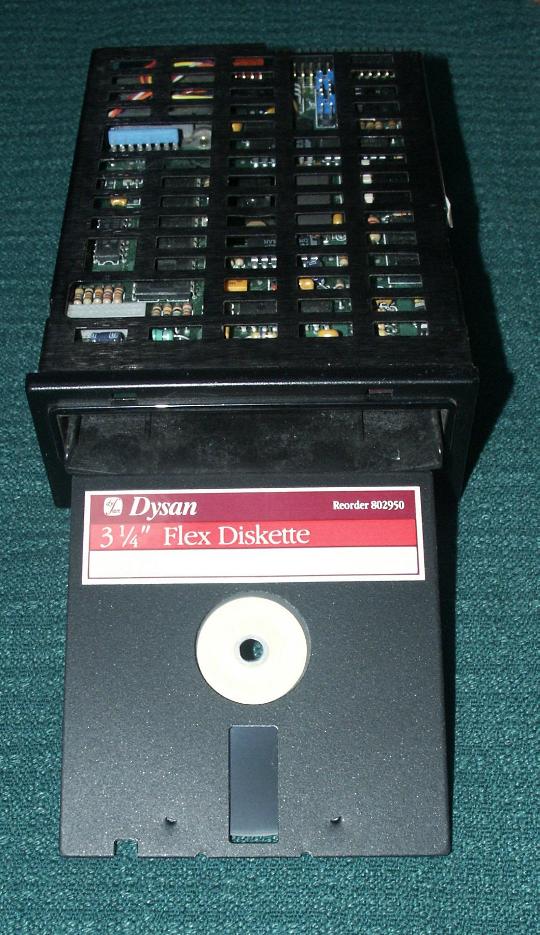
A floppy disk, diskette, or floppy diskette is a type of disk storage made from a thin, flexible disk coated with a magnetic storage medium. It is enclosed in a square or nearly square plastic shell lined with fabric to help remove dust from the spinning disk. Floppy disks store digital data, which can be read or written when inserted into a floppy disk drive (FDD) connected to or built into a computer or other device. The three most popular formats of floppy disks (and their drives) are the 8-inch, 5¼-inch, and 3½-inch versions. The first floppy disks, invented and made by IBM in 1971, had a disk diameter of . Subsequently, the 5¼-inch (130 mm) and then the 3½-inch (90 mm) became a ubiquitous form of data storage and data transfer into the first years of the 21st century. By the end of the 1980s, 5¼-inch (130 mm) disks had been superseded by 3½-inch (90 mm) disks. During this time, PCs frequently came equipped with drives of both sizes. By the mid-1990s, 5¼-inch drives had virtually disappeared, the 3½-inch disk became the dominant format. The advantages of the 3½-inch (90 mm) disk were its higher capacity, smaller physical size, and its rigid case which provided better protection from dirt and other environmental risks. Floppy disks were so common in late 20th-century culture that many electronic and software programs continue to use save icons that look like floppy disks well into the 21st century, as a form of skeuomorphic design. While floppy disk drives still have some limited uses, especially with legacy industrial computer equipment, they have been superseded by data storage methods with much greater data storage capacity and data transfer speed, such as USB flash drives, memory cards, optical discs, and storage available through local computer networks and cloud storage. 1) Hole indicates a high-capacity disk. 2) Hub engages with the drive motor. 3) Shutter protects the surface. 4) Plastic housing. 5) Polyester sheet reduces friction. 6) Magnetic-coated plastic disk. 7) Schematic of one sector (tracks/sectors not visible on real disks). 8) Write protection tab. In the early 1980s, many manufacturers introduced smaller floppy drives and media in various formats. A consortium of 21 companies eventually settled on a design known as the Micro diskette, Micro disk, or Micro floppy, similar to a Sony design but improved to support both single-sided and double-sided media, with formatted capacities generally of 360 kB and 720 kB respectively. Single-sided drives of the consortium design first shipped in 1983, and double-sided in 1984. The double-sided, high-density 1.44 MB (actually 1440 KiB = 1.41 MiB or 1.47 MB) disk drive, which would become the most popular, first shipped in 1986. IBM started using the 720 KB double density microfloppy disk on its Convertible laptop computer in 1986 and the 1.44 MB (1,474,560 bytes) high-density version with the IBM Personal System/2 (PS/2) line in 1987. These disk drives could be added to older PC models. In 1988, Y-E Data introduced a drive for 2.88 MB Double-Sided Extended-Density (DSED) diskettes which was used by IBM in its top-of-the-line PS/2 and some RS/6000 models and in the second-generation NeXTcube and NeXTstation; however, this format had limited market success due to lack of standards and movement to 1.44 MB drives. The first Macintosh computers used single-sided floppy disks, but with 400 kB formatted capacity. These were followed in 1986 by double-sided 800 kB floppies. The higher capacity was achieved at the same recording density by varying the disk-rotation speed with head position so that the linear speed of the disk was closer to constant. Later Macs could also read and write 1.44 MB HD disks in PC format with fixed rotation speed. Higher capacities were similarly achieved by Acorn's RISC OS (800 kB for DD, 1,600 kB for HD) and AmigaOS (880 kB for DD, 1,760 kB for HD). Most disks have a rectangular hole in one corner which, if obstructed, write-enables the disk. A sliding detented piece can be moved to block or reveal the part of the rectangular hole that is sensed by the drive. The HD 1.44 MB disks have a second, unobstructed hole in the opposite corner that identifies them as being of that capacity. In IBM-compatible PCs, higher-density floppy drives can read lower-density media, but writing and formatting across densities has reliability issues and was not officially supported by manufacturers. Writing at different densities than those at which disks were intended, sometimes by altering the density detection hole, was possible but not supported by manufacturers. A hole on one side of a disk can be altered to make some disk drives and operating systems treat the disk as one of higher or lower density, for bidirectional compatibility or economic reasons. Some computers, such as the PS/2 and Acorn Archimedes, ignored these holes altogether. Generally, the term floppy disk persisted, even though later style floppy disks have a rigid case around an internal floppy disk. === High-capacity=== A number of attempts were made by various companies to introduce newer floppy-disk formats, frequently characterized as a "super floppy," with many based on the standard 3½-inch physical form while offering much higher capacity. Many of these products provide the ability to read and write standard DD and HD disks. Some manufacturers offered high‑capacity floppy disk drives as standard components on their PCs (e.g. SuperDisk), but these drives never achieved the level of industry‑wide standardization reached by earlier floppy disk designs. They were later largely replaced first by optical disc burners and then by flash storage. In 1990, an attempt was made to standardize details for a 20MB 3½-inch format floppy. At the time, "three different technologies that are not interchangeable" existed. One major goal was that the to-be-developed standard drive be backward compatible: that it be able to read 720 KB and 1.44 MB floppies. === High-capacity disks=== The main technological change for the higher-capacity formats was the addition of tracking information on the disk surface to allow the read/write heads to be positioned more accurately. Most earlier generations of floppy disks have no such information, so the drives use open loop positioning by a stepper motor in order to position their heads over the desired track. For good interoperability of disks among drives, this requires precise alignment of the drive heads to a reference standard, somewhat similar to the alignment required to get the best performance out of an audio tape deck. The newer systems generally use position information on the surfaces of the disk to find the tracks, allowing the track width to be greatly reduced. The following summarizes specific structural differences in the several high-capacity FDs with more details contained in linked articles: Floptical The Floptical drive can read from and write 720 kB and 1.44 MB 3½-inch disks and uses infra-red LED to position the heads over marks in the disk surface to achieve a capacity of 21 MB on its high-capacity floppy disks. The drives are attached to the system using the SCSI interface instead of the usual floppy controller interface. It is considered to be the first actual super floppy. and its technology was licensed to a number of companies, who introduced compatible devices as well as even larger-capacity formats. The most popular of these, by far, was the LS-120. Flextra The Brier Flextra BR3020 announced at 21.4 MB could read and write 720 KB and 1.44 MB 3½-inch disks. Zip disk Physically both the media and cartridge were slightly larger but similar to other 3½-inch media and cartridges. A linear actuator positioned flying heads over high-capacity media that started at 100 MB and grew to 700 MB. It was offered in a variety of interfaces including PATA. LS-120/LS-240 LS, for LASER-servo, uses a LED to generate light that allows the drive to align its heads on high capacity FD media, initially at 120 MB and subsequently at 240 MB. The drive read and write 3½-inch 1,440 KB floppy disks, and some versions of the drive can write 32 MB onto a 3½-inch 1,440 kB disk albeit not too reliably. It was offered in a variety of interfaces including PATA. Sony HiFD Structurally similar to the Floptical and initially at 150 MB, it was removed from the market and subsequently reintroduced at 200 MB Caleb UHD144 Structurally similar to the Floptical it provides 144 MB of storage and is capable reading and writing 720 kB and 1.44 MB 3½-inch disks. ==Further reading== Weyhrich, Steven (2005). "The Disk II": A detailed essay describing one of the first commercial floppy disk drives (from the Apple II History website). Immers, Richard; Neufeld, Gerald G. (1984). Inside Commodore DOS: The Complete Guide to the 1541 Disk Operating System. Datamost & Reston Publishing Company (Prentice-Hall). . Englisch, Lothar; Szczepanowski, Norbert (1984). The Anatomy of the 1541 Disk Drive. Grand Rapids, Michigan, USA, Abacus Software (translated from the original 1983 German edition, Düsseldorf, Data Becker GmbH). . Hewlett Packard: 9121D/S Disc Memory Operator's Manual; printed 1 September 1982; part number 09121-90000.
References
- ^ X3.162 , ANSI, 1994, archived from the original on 28 February 2022 , retrieved 28 February 2022 , Information Systems – Unformatted Flexible Disk Cartridge for Information Interchange, 5.25 in (130 mm), 96 Tracks per inch (3.8 Tracks per Millimeter), General, Physical, and Magnetic Requirements (includes ANSI X3.162/TC-1-1995) Specifies the general, physical, and magnetic requirements for interchangeability for the two-sided, 5.25 in (130 mm) flexible disk cartridge Wikipedia revision 1376374018, retrieved 2026-11-18 · 1794956400.0
- ^ IBM. IBM Personal Computer DOS 1.0: User's Guide and Reference . IBM Corporation, 1981. Wikipedia revision 1376374018, retrieved 2026-11-18 · 1794956400.0
- ^ Digital Research. CP/M Operating System Manual . Digital Research Inc., 1977. Wikipedia revision 1376374018, retrieved 2026-11-18 · 1794956400.0
- ^ Apple Computer Inc. Apple DOS Programmer's Manual . Apple Computer, 1978. Wikipedia revision 1376374018, retrieved 2026-11-18 · 1794956400.0
- ^ Microsoft. MS-DOS User's Guide . Microsoft Press, 1983. Wikipedia revision 1376374018, retrieved 2026-11-18 · 1794956400.0
- ^ "What is skeuomorphism?" . The Interaction Design Foundation . Retrieved 20 February 2026 . Wikipedia revision 1376374018, retrieved 2026-11-18 · 1794956400.0
- ^ "Apple Floppy Drives – Apple II / Macintosh" (PDF) . Apple II Documentation Project . Retrieved 1 November 2025 . GCR disks cannot be read by standard PC disk controllers. Wikipedia revision 1376374018, retrieved 2026-11-18 · 1794956400.0
- ^ a b c Bateman, Selby (March 1986). "The Future of Mass Storage" . Compute! . No. 70. Compute! Publications, Inc. p. 18. Archived from the original on 1 July 2018 . Retrieved 7 October 2018 . Wikipedia revision 1376374018, retrieved 2026-11-18 · 1794956400.0
- ^ a b "Three-inch floppy disk product announced" (PDF) . Archived from the original (PDF) on 8 August 2012 . Retrieved 4 October 2008 . Wikipedia revision 1376374018, retrieved 2026-11-18 · 1794956400.0
- ^ Stack, Liam (24 October 2019). "Update Complete: U.S. Nuclear Weapons No Longer Need Floppy Disks" . The New York Times . Retrieved 1 October 2025 . Wikipedia revision 1376374018, retrieved 2026-11-18 · 1794956400.0
- ^ BR-3225 3.5″ 25 MB Floppy Disk Drive (PDF) (Report). Brier Technology. 1989. Archived from the original on 15 August 2023 . Retrieved 9 August 2025 . Enhanced electronics permit the BR-3225 to read IBM formatted 3.5 inch floppy disks. The drive automatically identifies 1 MB, 2 MB, or 25 MB disks… Servo: magnetically embedded (buried). {{ cite report }} : CS1 maint: bot: original URL status unknown ( link ) Wikipedia revision 1376374018, retrieved 2026-11-18 · 1794956400.0
- ^ Pollack, Andrew (14 March 1990). "The Evolution of the Floppy Disk for PCs" . The New York Times . Business Technology . Retrieved 19 June 2017 . […] The Brier ... can store 20 megabytes, increase the number of tracks. […] In Brier's Flextra system, a low-frequency magnetic homing signal is embedded at the bottom of the barium ferrite coating after the disk is manufactured. Later, the data are recorded in the top of the layer, using a higher-frequency signal. The Brier system cannot read and write lower-capacity disks, although the company says it will introduce a model that can do that later this year. […] Brier has designed its system from scratch to achieve higher speeds. Wikipedia revision 1376374018, retrieved 2026-11-18 · 1794956400.0
- ^ "LS-120" , PC Magazine (encyclopedia term) {{ citation }} : CS1 maint: deprecated archival service ( link ) Wikipedia revision 1376374018, retrieved 2026-11-18 · 1794956400.0
- ^ "Federal Agencies Need to Address Aging Legacy Systems" (PDF) . Report to Congressional Requesters . United States Government Accountability Office. May 2016. Archived (PDF) from the original on 2 June 2016 . Retrieved 26 May 2016 . Wikipedia revision 1376374018, retrieved 2026-11-18 · 1794956400.0
- ^ "Chronology of Events in the History of Microcomputers − 1981–1983 Business Takes Over" . Archived from the original on 7 December 2008 . Retrieved 4 October 2008 . Wikipedia revision 1376374018, retrieved 2026-11-18 · 1794956400.0
- ^ "IBM History – Floppy disk storage" . IBM . 16 May 2024. Archived from the original on 16 June 2024 . Retrieved 16 June 2024 . Wikipedia revision 1376374018, retrieved 2026-11-18 · 1794956400.0
- ^ "You've probably seen a 3.5-inch floppy disk, but what were the dimensions of the technology's first iteration?" . TechSpot . Retrieved 28 July 2025 . Wikipedia revision 1376374018, retrieved 2026-11-18 · 1794956400.0
- ^ Watson (24 May 2010). "The Floppy Disk". Canadian Business . Vol. 83, no. 8. p. 17. Wikipedia revision 1376374018, retrieved 2026-11-18 · 1794956400.0
- ^ "When did 5.25″ floppies exceed the capacity of 8″?" . Retrocomputing . Single-sided double-density (SSDD) systems used original media, 40 tracks and MFM encoding for a capacity of around 160 KB/diskette. Double-sided double-density (DSDD or sometimes "2D") systems obviously doubled the above to about 320 KB/diskette.access-date=20 November 2024 Wikipedia revision 1376374018, retrieved 2026-11-18 · 1794956400.0
- ^ Porter, James (November 1992). 1992 Disk/Trend Report - Flexible Disk Drives (Report). p. DT14-3. Wikipedia revision 1376374018, retrieved 2026-11-18 · 1794956400.0
- ^ Picture of disk Wikipedia revision 1376374018, retrieved 2026-11-18 · 1794956400.0
- ^ 1991 Disk/Trend Report, Flexible Disk Drives, Figure 2 Wikipedia revision 1376374018, retrieved 2026-11-18 · 1794956400.0
- ^ a b Mike Brutman. "Working with Disks" . Retrieved 29 July 2025 . So the short story is don't write a double density diskette in a high density drive and then expect a double density drive to be able to read it. The narrower write head overwriting the wider preexisting data can confuse the wider drive head Wikipedia revision 1376374018, retrieved 2026-11-18 · 1794956400.0
- ^ "History (1976): 5.25-Inch Minifloppy Disk" . StorageNewsletter . 26 November 2018 . Retrieved 28 July 2025 . Wikipedia revision 1376374018, retrieved 2026-11-18 · 1794956400.0
- ^ Porter (November 1993). DISK/TREND REPORT, FLEXIBLE DISK DRIVES . p. DT14-2. Wikipedia revision 1376374018, retrieved 2026-11-18 · 1794956400.0
- ^ Shea, Tom (13 June 1983). "Shrinking drives increase storage" . InfoWorld . pp. 1, 7, 8, 9, 11. Shugart is one of the major subscribers to the 3 1 ⁄ 2 -inch micro-floppy standard, along with Sony and 20 other company ... Its single-sided SA300 micro-floppy drive offers 500K of unformatted storage. Shugart's Kevin Burr said the obvious next step is to put another 500K of storage on the other side of the diskette and that the firm will come out with a double-sided 1-megabyte micro-floppy drive soon. Wikipedia revision 1376374018, retrieved 2026-11-18 · 1794956400.0
- ^ "Floppy Disk: History & Definition" . Encyclopedia Britannica . 12 March 2009. Archived from the original on 16 June 2024 . Retrieved 16 June 2024 . Wikipedia revision 1376374018, retrieved 2026-11-18 · 1794956400.0
- ^ 1986 Disk/Trend Report – Flexible Disk Drives . Disk/Trend, Inc. November 1986. p. FSPEC-59. Reports Sony shipped in 1Q 1986 Wikipedia revision 1376374018, retrieved 2026-11-18 · 1794956400.0
- ^ "Were commercial Amiga floppy disks shipped with write protection?" . Retrocomputing Stack Exchange . Retrieved 29 July 2025 . There were in fact 'hard' protected disks - such that simply had no write protect hole. These were used by software distributions Wikipedia revision 1376374018, retrieved 2026-11-18 · 1794956400.0
- ^ "Mismatched floppy disk/drive reading and writing, what should one keep in mind?" . Retrocomputing Stack Exchange . Retrieved 28 July 2025 . Wikipedia revision 1376374018, retrieved 2026-11-18 · 1794956400.0
- ^ "Managing Disks" . Carol RPT . Retrieved 28 July 2025 . Wikipedia revision 1376374018, retrieved 2026-11-18 · 1794956400.0
- ^ "Formatting 720K Disks on a 1.44MB Floppy" . Floppy Drive . Archived from the original on 23 July 2011 . Retrieved 11 February 2011 . Wikipedia revision 1376374018, retrieved 2026-11-18 · 1794956400.0
- ^ Spring, Tom (24 July 2002). "What Has Your Floppy Drive Done for You Lately? PC makers are still standing by floppy drives despite vanishing consumer demand" . PC World . Archived from the original on 24 December 2011 . Retrieved 4 April 2012 . Wikipedia revision 1376374018, retrieved 2026-11-18 · 1794956400.0
- ^ "R.I.P. Floppy Disk" . BBC News . 1 April 2003. Archived from the original on 16 February 2009 . Retrieved 19 July 2011 . Wikipedia revision 1376374018, retrieved 2026-11-18 · 1794956400.0
- ^ Swift, Rocky (3 July 2024). "Japan declares victory in effort to end government use of floppy disks" . Reuters . Wikipedia revision 1376374018, retrieved 2026-11-18 · 1794956400.0
- ^ "How to use Floppy Disk on Windows 10" . 9 March 2016. Archived from the original on 17 November 2018 . Retrieved 11 June 2019 . Wikipedia revision 1376374018, retrieved 2026-11-18 · 1794956400.0
- ^ Warren, Tom (11 August 2020). "Boeing 747s still get critical updates via floppy disks: A rare look inside a 20-year-old airliner" . The Verge . Vox Media . Retrieved 26 February 2021 . Wikipedia revision 1376374018, retrieved 2026-11-18 · 1794956400.0
- ^ "1971: Floppy disk loads mainframe computer data" . Computer History Museum . Archived from the original on 8 December 2015 . Retrieved 1 December 2015 . Wikipedia revision 1376374018, retrieved 2026-11-18 · 1794956400.0
- ^ "Notice of Termination of Sales of 3.5-inch Floppy Disks" . Sony Japan . 23 April 2010 . Retrieved 14 September 2022 . Wikipedia revision 1376374018, retrieved 2026-11-18 · 1794956400.0
- ^ Sorrel, Charlie (26 April 2010). "Sony Announces the Death of the Floppy Disk" . Wired . Retrieved 14 September 2022 . Wikipedia revision 1376374018, retrieved 2026-11-18 · 1794956400.0
- ^ Robinson, Dan (20 September 2022). " 'Last man standing in the floppy disk business' reckons his company has 4 years left" . The Register . Retrieved 23 September 2022 . Wikipedia revision 1376374018, retrieved 2026-11-18 · 1794956400.0
- ^ "What is a Floppy Disk?" . GeeksforGeeks . 6 March 2024 . Retrieved 26 January 2025 . Wikipedia revision 1376374018, retrieved 2026-11-18 · 1794956400.0
- ^ "What is a Floppy Disk? Definition, Advantages & Disadvantages" . Study.com . Retrieved 22 February 2025 . Wikipedia revision 1376374018, retrieved 2026-11-18 · 1794956400.0
- ^ "Write Protect Notch" . PCMag Encyclopedia . Retrieved 22 February 2025 . Wikipedia revision 1376374018, retrieved 2026-11-18 · 1794956400.0
- ^ "Floppy Disk / Diskettes // Retrocmp / Retro computing" . Wikipedia revision 1376374018, retrieved 2026-11-18 · 1794956400.0
- ^ "The Disk II" . Apple II History . 2 December 2008. Archived from the original on 19 February 2018 . Retrieved 17 February 2018 . Wozniak's technique would allow the drive to do self-synchronization ("soft sectoring"), not have to deal with that little timing hole, and save on hardware. Wikipedia revision 1376374018, retrieved 2026-11-18 · 1794956400.0
- ^ "What is a Floppy Disk?" . Lenovo . Retrieved 28 July 2025 . Extra Density (ED): Consists of 3 μm barium ferrite Wikipedia revision 1376374018, retrieved 2026-11-18 · 1794956400.0
- ^ Markus Kuhn. "International standard paper sizes" . University of Cambridge . Retrieved 28 July 2025 . ISO 838 specifies that, for filing purposes, two holes of 6±0.5 mm diameter can be punched into the sheets. The centers of the two holes are 80±0.5 mm apart Wikipedia revision 1376374018, retrieved 2026-11-18 · 1794956400.0
- ^ "Five decades of disk drive industry firsts" . Archived from the original on 26 July 2011 . Retrieved 15 October 2012 . Wikipedia revision 1376374018, retrieved 2026-11-18 · 1794956400.0
- ^ Norman, Donald (1990). "Chapter 1". The Design of Everyday Things . New York, US: Doubleday . ISBN 0-385-26774-6 . Wikipedia revision 1376374018, retrieved 2026-11-18 · 1794956400.0
- ^ Porter, Jim, ed. (2005). "Oral History Panel on 8 inch Floppy Disk Drives" (PDF) . p. 31. Archived from the original (PDF) on 13 May 2015 . Retrieved 22 June 2011 . Wikipedia revision 1376374018, retrieved 2026-11-18 · 1794956400.0
- ^ US 4722010A , "Read circuit for floppy disk drive", issued 26 January 1988 Wikipedia revision 1376374018, retrieved 2026-11-18 · 1794956400.0
- ^ "How to at least partially read damaged sectors of floppy disk?" . Retrocomputing Stack Exchange . Retrieved 29 July 2025 . Wikipedia revision 1376374018, retrieved 2026-11-18 · 1794956400.0
- ^ "Error reading disk when disk is not a hard drive" . Stack Overflow . Retrieved 28 July 2025 . It is also a good idea on real hardware to retry a disk operation a few times if it fails. You can do that by calling BIOS function Int 13h/AH=0 (Disk Reset) before retrying the operation again. If it fails more than a few times then you can abort Wikipedia revision 1376374018, retrieved 2026-11-18 · 1794956400.0
- ^ "Abort, Retry, Fail?" . Wikipedia . Retrieved 28 July 2025 . Similarly, CP/M would repeatedly read or write a disk sector as long as there was an error Wikipedia revision 1376374018, retrieved 2026-11-18 · 1794956400.0
- ^ "Flexible magnetic disk clamping an injector mechanism" . Justia Patents . 3 September 1985 . Retrieved 28 July 2025 . A floppy disk drive mechanism includes a clamping lever which is turned to align the floppy disk with a drive spindle and clamp it thereto Wikipedia revision 1376374018, retrieved 2026-11-18 · 1794956400.0
- ^ a b "Parts of a Floppy Disk Drive" . HowStuffWorks . 26 February 2001 . Retrieved 28 July 2025 . A system of levers that opens the little protective window on the diskette to allow the read/write heads to touch the dual-sided diskette media Wikipedia revision 1376374018, retrieved 2026-11-18 · 1794956400.0
- ^ IBM's 370/145 Uncovered; Interesting Curves Revealed, Datamation, November 1, 1970 Wikipedia revision 1376374018, retrieved 2026-11-18 · 1794956400.0
- ^ "Flexible magnetic disk clamping and ejector mechanism" . Google Patents . 1984 . Retrieved 28 July 2025 . Because of spring loading, the linkages involved with insertion and clamping of the disk provide a force, upon release, by pushing the release button, that strikes against the rear edge of the cartridge containing said disk and applies an ejection force thereto Wikipedia revision 1376374018, retrieved 2026-11-18 · 1794956400.0
- ^ "How to Generate Floppy Disks for Old Macintosh Computers" . Hardware Secrets . 24 February 2023 . Retrieved 28 July 2025 . Floppy disk drives for Macintosh computers have an electric ejecting mechanism, so there is no eject button on Macintosh floppy disk drives Wikipedia revision 1376374018, retrieved 2026-11-18 · 1794956400.0
Cite this
"Floppy disk". 1790186757. e01 Encyclopedia. CC BY-SA 4.0. https://en.wikipedia.org/w/index.php?oldid=1376374018 JSON record · API collection · BibTeX · RIS · CSL-JSON · citation policy